Proof of Humanity and Sybil Defense for Web3 Communities: When to Start Verifying Users and What Tools to Use
Dec 16, 2025

Learn when growing web3 communities need proof of humanity and how Sybil defense fits into community design. This overview walks through key breakpoints, practical tools that support verification, and real examples using Human Passport.
In the web3 space, where community building sits right next to chasing vanity metrics, creating a sustainable, genuine audience ain’t easy.
When monetary rewards are at stake, it’s challenging to know whether people joining your channels are here for the product, the vibe, the shared experience, or just the rewards they expect. This is where Goodhart’s Law starts to show: “When a measure becomes a target, it ceases to be a good measure.” Community counts rise, engagement spikes, but you no longer know how much of it comes from actual, real humans.
Unless you keep track of who's entering the community.
Human verification is how teams bring clarity back into the system.
Keeping the community human
If you’ve spent any time in web3, you’ve probably come across “proof of humanity” or “proof of personhood.” These are the processes communities use to defend themselves from Sybil and bot activity, which often shows up as floods of fake or duplicated identities. You can easily apply these checks in your own setup.
Sybil behavior distorts participation, drains rewards, and destabilizes governance, so early filtering matters.
Professional proof of humanity systems offer reliable ways to spot bad actors before they enter your spaces. You can gate your Telegram or Discord community with human checks; event subscription may require purchasers to be human; form submissions can also be protected.
Once you add verification to your onboarding flow, it becomes clear how many real people are engaging in your community.
When should I start checking humanity?
This is a crucial question that any project asks itself. While there isn’t a clear-cut answer, there are good anchor points to when it’s generally good to start applying human verification, and when it’s absolutely necessary.
You open the community to the public
Your curated community has grown, and you are opening the gate to the public. Given you’ll no longer be fully aware who is joining, and for what reasons, it’s a good moment to start checking. Humanity proof gives you this extra assurance that at least you are not welcoming 100 copies of the same member.
You introduce rewards or governance
This is another breakpoint. In the lifespan of most web3 communities, there comes a time when you either want to introduce governance to increase agency and participation, or you want to grow your community, and offering tokens or ecosystem rewards is a great way to enable this. Rewards are an obvious Sybil-attractor, but so is the governance - someone pretending to be many may shift the direction the project turns. This may happen for various reasons, like personal gains, competition, or just malice.
You launch a token
This is a no–brainer. Few moments attract coordinated Sybil behaviour more than a token launch. You can start your Sybil checks as part of your criteria for TGE, for example, by gating testnet or faucet access. You can also perform an analysis of the collected wallet addresses towards the end of the launch campaign.
Early verification improves outcomes
It’s worth mentioning that implementing Sybil defense earlier in the project’s lifecycle can lead to better results, as it sets the tone that you’re prioritizing humans in your ecosystem and your community develops resilience over time. It also reduces potential public scrutiny, since Sybils are removed gradually rather than all at once, reducing the risk of amplifying ‘fud’ and negative community sentiment in a snowball effect.
Story protocol followed this approach for their $IP airdrop, introducing human verification already at testnet.
What tools can I use?
There are multiple proofs of personhood, community gating, and Sybil resistance tools available in the ecosystem. Some focus on privacy, some on simplicity, and some on deeper verification. Every project needs to evaluate these options carefully before integrating them. We’re preparing a comparison framework for the PoH providers - soon to be released.
Human Passport (previously Gitcoin Passport)
Human Passport is one of the available PoH solutions. If you choose to use it, good news: both the Passport App and the Passport Embed are free for builders. The Embed offers a smoother user experience and is recommended. You can select your preferred set of Stamps and set your own humanity threshold; we suggest a threshold of 20, since the system is calibrated for that score. You can follow the integration guide here.
You can also access Passport through products that already integrate it. These tools use our scoring or verification inside their own flows, so you can benefit from humanity checks without building an integration yourself. Below is the full list.
Unlock
Ticket, subscription, membership gating
Unlock is a programmable NFT framework for onchain access control. Projects can use Unlock to gate tickets, subscriptions, or memberships and attach custom verification logic to each Lock. The Passport Hook adds humanity checks directly into the checkout process by using the Unique Humanity score. Teams can choose their own threshold for access, and users who fall below it can build their score before completing the purchase. For a deeper look at how this integration works, see our detailed guide or the full blog post.
Discourse
Discussion forum
Discourse is a popular platform for long-form community discussion. It supports structured threads, persistent conversations, and member roles that grow with participation. Human Passport integrates through simple gating rules that check for real users before they can join or post, helping communities block bots and reduce Sybil activity without adding friction.
Formo
Form gating + analytics
Formo adds humanity checks to forms, surveys, and waitlists, filtering out bots before responses land in your dashboard. Passport verification integration runs at submission time and helps keep allowlists, registrations, and feedback collections grounded in real users.
Collab.Land
Community entry gating
Collab.Land lets you control who enters your Discord or Telegram spaces. By adding a Passport requirement to the join flow, communities can keep out bot floods and duplicated identities before conversations even begin.
Snapshot
Voting protection
Snapshot proposals can use Passport as part of the voting strategy, either as a requirement or as a scoring signal. This helps DAOs limit influence from scripted wallets or repeated identities and keeps vote outcomes closer to real community participation.
Galxe
Community quests + reward gating
Galxe lets communities run quests, missions, and reward flows that require users to verify their humanity before claiming. Passport scoring can be added to quest requirements (credentials) to limit bots and repeated identities during community growth, making participation stats and reward distribution more reliable. *search for Gitcoin Passport
Layer3
Community quests + task verification
Layer3 runs quests and tasks that onboard and activate community members. By integrating Passport scoring, Layer3 can weigh or restrict participation based on humanity signals, making it harder for automated clusters to farm rewards or distort engagement. *search for Gitcoin Passport
.png&w=3840&q=75&dpl=dpl_9okjpShoRL9iN4vGNqzq7ofkYbwV)
| Logo | Name | Category | What it does | Passport integration |
|---|---|---|---|---|
| Unlock | Memberships / Ticketing | Onchain access for memberships, tickets, subscriptions | Passport Hook checks humanity score at checkout | |
| Discourse | Forum | Human-verified fosum discussions | Verification rules that admit real users and block Sybils | |
| Formo | Forms / Waitlists | Gated forms, surveys, waitlists | Passport verification runs at form submission | |
| Collab.Land | Entry Gating | Controls who joins Discord / Telegram | Passport check in the join flow | |
| Snapshot | Governance | Gasless DAO voting with custom strategies | Passport strategy for voting requirement or weighting | |
| Layer3 | Quests | Task-based quests for user activation | Passport score filter for tasks and participation | |
| Galxe | Campaigns / Quests | Missions, credentials, and reward flows | Passport credential as a quest requirement |
A real example in practice
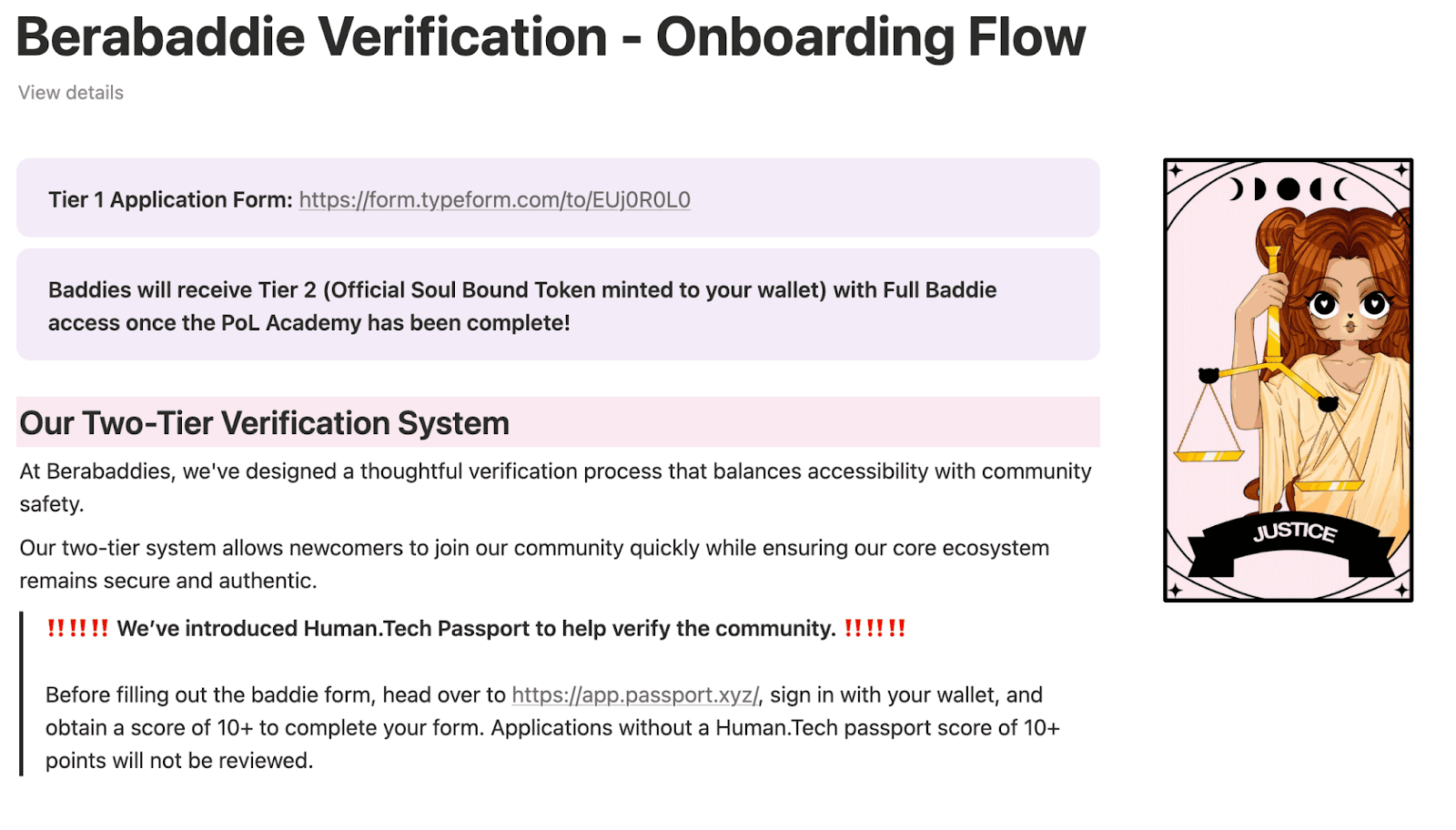
Berabaddies is a community many people in web3 recognize. During their early growth, they added Human Passport as Step 2 of their onboarding flow. The team used the Passport API together with Stamps in the Passport App to verify each new member before giving access to community spaces - the most standard and widely used implementation of Passport.
Now that Embed is live, we recommend using it for a smoother experience. Users no longer need to leave your flow to open the Passport App.
The setup worked because it introduced a light humanity check at the exact moment it mattered: right before joining. Verification sat inside the existing onboarding flow, so users did not feel confused. For the team, the integration took little work (just a few lines of code) and immediately removed duplicated identities that were starting to appear during peak activity.
You can apply the same pattern to your own community.
How to set this up for your community
- **Create a Scorer and API** in the Passport Developer Portal and copy your Scorer ID.
- Check the user’s score during onboarding using that Scorer ID.
- Gate access based on whether the user’s score meets your specified threshold.
Users who need to verify can do it through the Passport App or through Passport Embed inside your UI. Note that this is a direct implementation of Human Passport and requires some coding. You can also use the tools mentioned in the previous section as a fully no-code solution. Those tools have Passport already integrated, and they will check the Unique Humanity score for you.
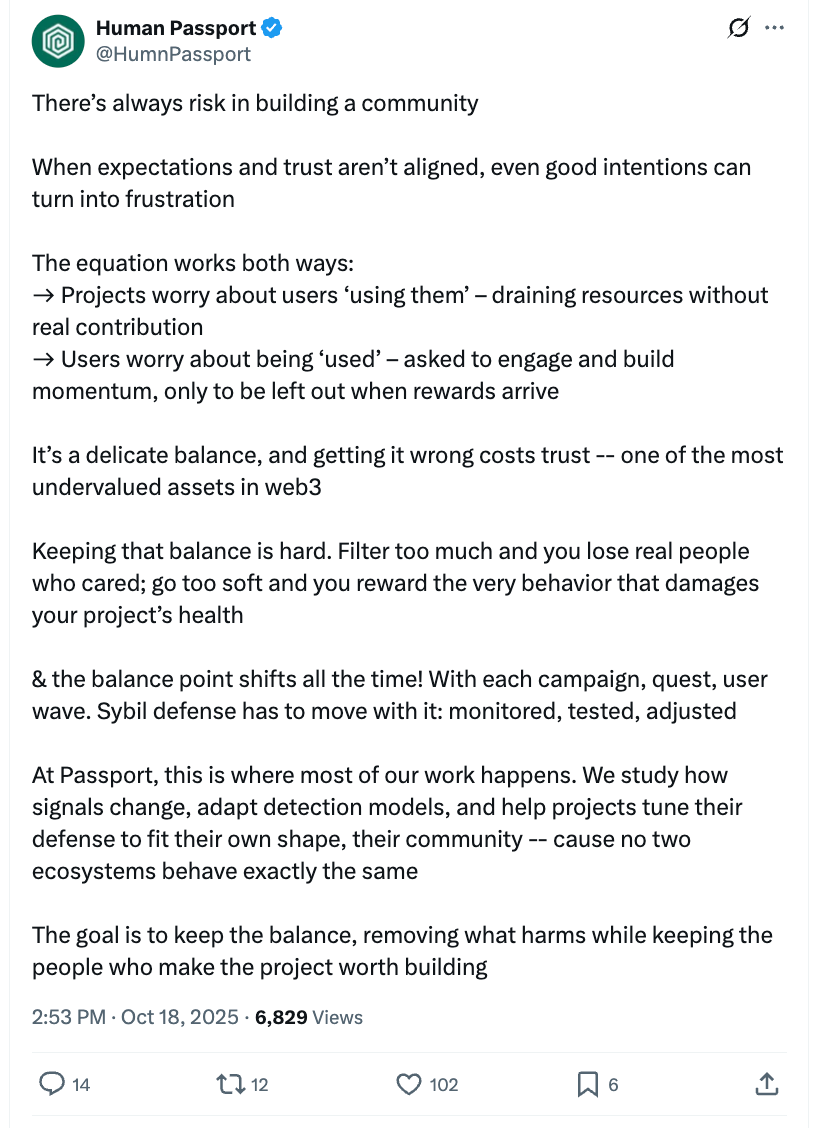
https://x.com/HumnPassport/status/1979531162516361249
FAQ
I have a small community. Why would I care?
You are usually fine without Sybil defense as long as you or your team manually curate who joins. If your community is hard to find or invitation-only, the risk is low. Be ready to adjust when you open the doors to the public, introduce governance, or add rewards. These moments attract Sybils the fastest.
What risks does an unverified, ungated community bring?
Spam and bot activity can overwhelm channels, skew sentiment, and distort any polls you run. Governance can be influenced by a single person using many wallets. Rewards and airdrops can be farmed, letting a few actors capture value meant for the broader community. Over time, this erodes trust, drains resources, and destabilizes token or community dynamics.
How do I choose the right proof of humanity tool? They all look similar.
Many tools look alike on the surface. To differentiate:
- Check adoption. Reliable tools tend to be used by teams you recognize.
- Check GitHub. Active code and transparent repos signal maturity.
- Check the docs. Clear documentation usually reflects a clear design.
- Evaluate the human signal. If the tool enables users to verify using verification types that don’t have a strong human signal, then Sybils will likely be able to game it. There is a little intuition around this one, but you can soon read more in our blog post on ‘how to choose the right proof of humanity tool.’
Does it matter if the tool is privacy-preserving?
Yes. If a system stores user data, it can be leaked, hacked, or abused. A privacy-preserving tool keeps sensitive information off-chain and un-stored, which means there is no way for bad actors to be able to identify who owns the account. They will only be able to identify that the individual behind the account is a unique human.