Inside Shield: A Programmable Privacy Bridge to Aztec Tierra (Alpha V6)
Nov 25, 2026

Shield by human.tech is a programmable privacy bridge to and from Aztec, built on Clean SDK. It launched on Aztec mainnet in July 2026 as a V5 launch partner, supporting USDC with accountability built in. It now runs on Aztec Tierra (Alpha V6).
Shield’s V6 deployment makes smaller transfers simpler: users can bridge up to $100 a day with sanctions screening alone, without identity verification. It also adds ETH alongside USDC. The core design carries over to a new set of contracts.
The announcement explains what users can do on Tierra. This post follows the contracts: why Tierra required new contracts, how Clean tokens work, where Shield checks transfers, and what changed from V5. It also examines the limits of Shield’s privacy guarantees and the powers retained by contract owners.
TL;DR
- Tierra starts a fresh rollup, so Shield redeployed its contracts on Ethereum and Aztec. Balances do not carry over. If you still have funds on V5, contact support through the chat bubble.
- USDC and ETH arrive as cUSDC and cWETH: standard Aztec tokens that mint only from a screened, approved deposit, and that you can integrate through the usual token interface. Shield’s checks happen at deposit and exit, rather than on transfers within Aztec.
- Shield never holds your keys; your deposit sits in a smart contract. The portal owner, a single key, can pause portals and use an emergency rescue function that can move any token they hold, including deposits.
- V6 tightens Proof of Clean Hands deposit approvals: each approval applies to one portal and a maximum amount, and expires 30 minutes after Shield issues it.
- Clean SDK 0.3.0 supports V6, so developers can integrate Shield’s checks into their own apps, with cUSDC and cWETH available on testnet.
Why a new rollup means a new bridge
To see why Shield needed new contracts, let’s start with what Aztec changed. Tierra is not an upgrade of the V5 network. It starts a new rollup from genesis, and every contract address, account addresses included, differs from V5. It brings new circuits and a new verification-key tree, addresses vulnerabilities including the critical V5 issue, and adds security hardening. Users will notice the speed first. A new Fast Inbox delivers Ethereum-to-Aztec messages in about 12 to 30 seconds, down from 24 to 108 seconds. Client-side proofs on a native device are about twice as fast.
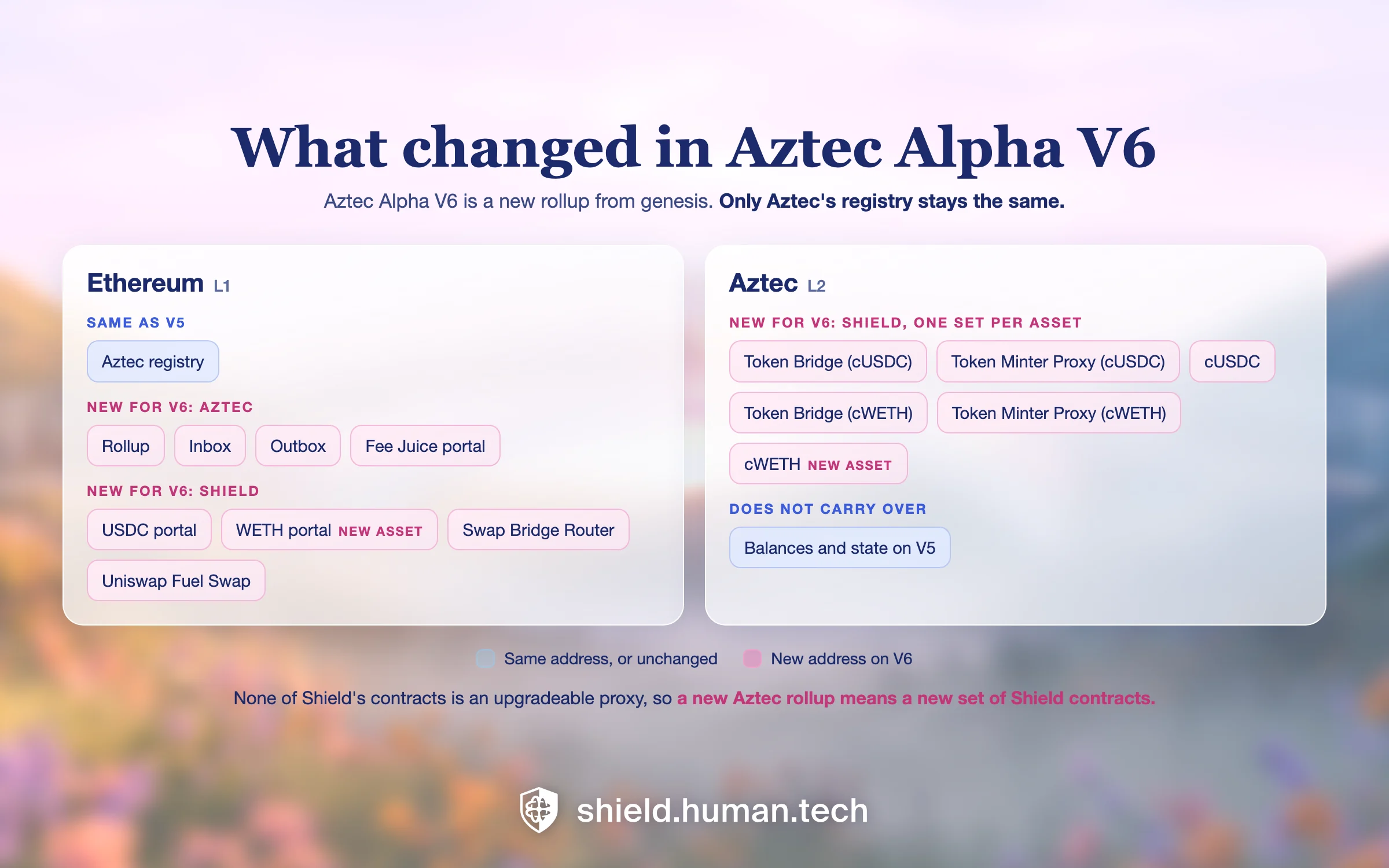
That fresh start matters for a bridge because of how Shield’s contracts talk to Aztec. Shield’s Ethereum deposit contract, called a portal in Aztec’s architecture, holds the tokens. You keep your wallet keys; deposited funds sit in the contract, not a Shield account. The portal sends a message through the rollup’s Inbox. The Aztec bridge consumes that message to mint tokens, while the return journey uses the Outbox. Each portal reads Aztec’s registry once during initialization, stores the Inbox, Outbox and rollup version, and includes that version in its messages. A portal initialized for V5 stays bound to the V5 rollup.
Although Aztec’s registry keeps its Ethereum address, the rollup, Inbox, Outbox and Fee Juice portal all have new ones. Shield’s contracts have no upgradeable proxies, so reconnecting to V6 meant deploying a new Ethereum portal for each token, plus a new bridge, minter proxy and token for each asset on Aztec. Funds are not migrated, so balances on V5 stay on V5. If you still hold Clean tokens there, contact support through the chat bubble at shield.human.tech or on Discord to get them out.
Shield deployed its router, fuel swap and USDC portal on Ethereum on November 2, 2026, followed by the WETH portal on November 3.
What makes cUSDC and cWETH Clean tokens
When you bridge funds to Aztec with Shield, you receive them in a specific form, called Clean tokens. USDC arrives as cUSDC, and ETH or WETH as cWETH. A Clean token is an ordinary Aztec token, set apart by how it is minted. None can be created without an approval that passed Shield’s checks. It follows the usual transfer rules and carries no identity data. Four contracts on the deposit path enforce the approval required to mint them.
- The Ethereum portal verifies a signed approval for the depositor, then sends a message to Aztec.
- The Aztec bridge consumes a message from its own portal before minting through the proxy.
- The proxy accepts mints from its allowlist. Shield’s deploy script initially allows only that token’s bridge.
- The token is deployed with the proxy as its minter.
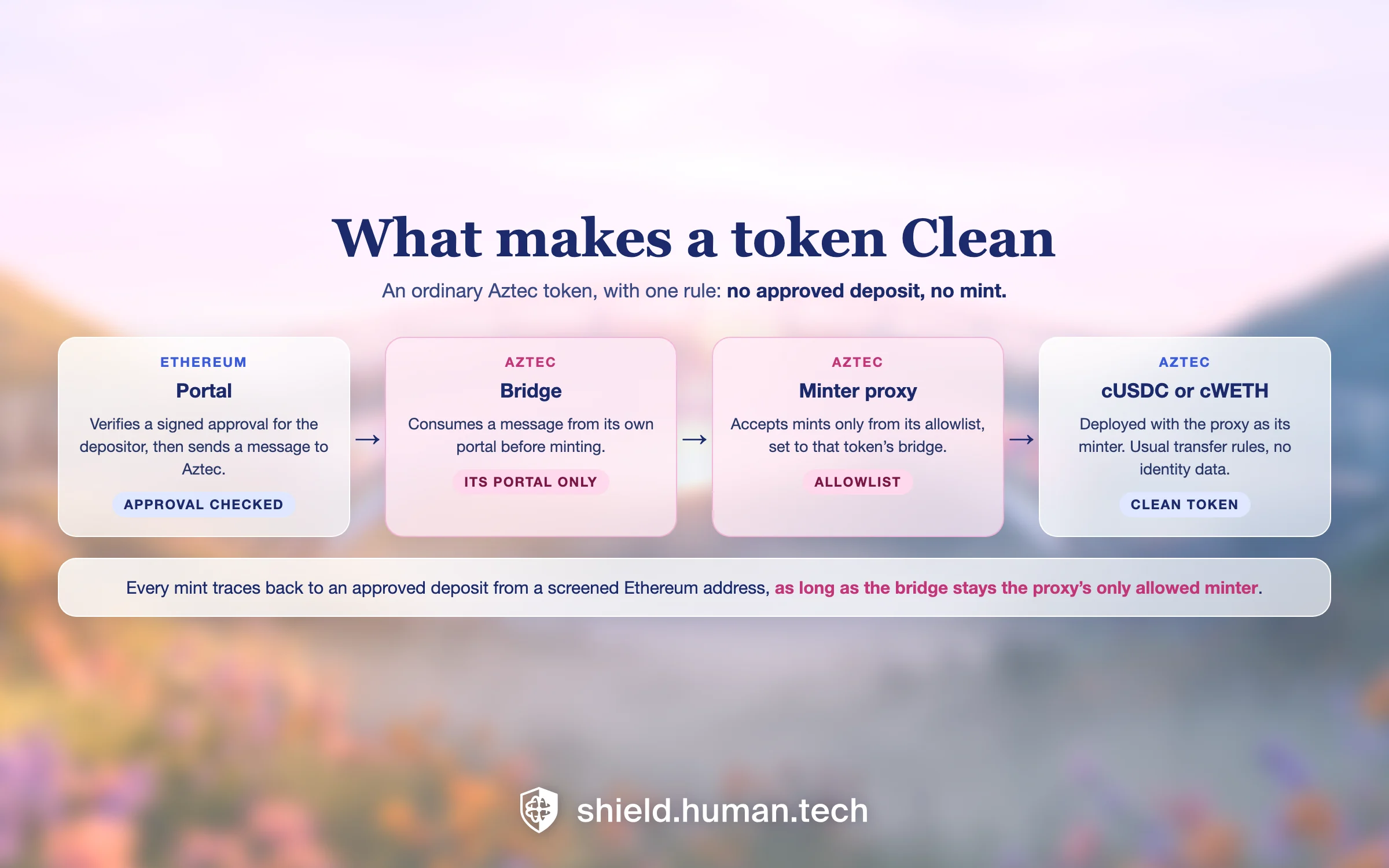
Together, those contracts tie every mint to a deposit approved for a screened Ethereum address, as long as the bridge remains the proxy’s only allowed minter. Each portal’s bridge issues its own token, so cUSDC is separate from USDC brought to Aztec by another bridge.
Public deposits credit a public balance, and private deposits deliver private notes of the same token. Both use the same approval rule as in V5. Shield checks the Ethereum address at entry and exit, with additional checks on the person at higher limits. It does not trace token history.
These checks come from Clean SDK, human.tech’s programmable privacy toolkit. Shield is the first app built on it.
Where Shield checks a transfer
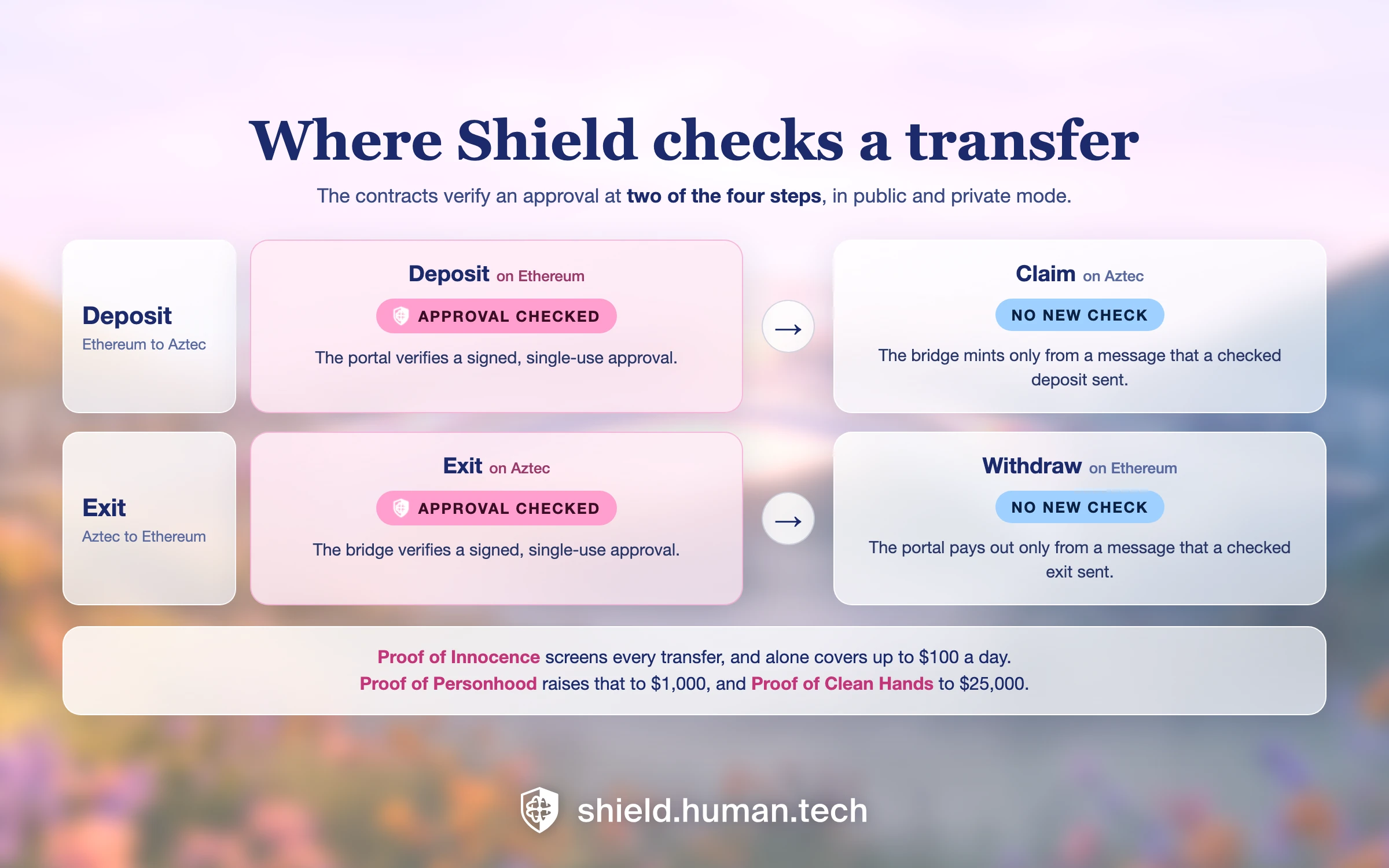
The mint rule depends on an approval. Shield decides offchain whether to approve a depositor. Its contracts verify that approval at deposit and exit. Proof of Innocence screens the Ethereum address.
The amount determines what else the user needs. Limits apply per user over a rolling 24 hours, counted separately for deposits and withdrawals. Up to $100 a day, address screening alone is enough.
A Human Passport score, formerly Gitcoin Passport, provides Proof of Personhood for up to $1,000 a day. Above that, the user needs a zero-knowledge government-ID check for Proof of Clean Hands, which covers up to $25,000 a day. That check is free while Shield’s subsidy pool lasts.
Deposits from all users together are also capped at $100,000 a calendar month (as of November 2026).
Verification alone does not produce an approval. When screening is enabled, the server code checks the Ethereum address against 23 sanctions and watchlist sources before signing. If the screening service does not respond, the server refuses to sign. Deposits and exits wait until screening returns. Every exit needs a new approval. If the server or screening is unavailable, funds stay on Aztec until it returns. There is no other exit path.
| Step | Chain | Does the contract check an approval? |
|---|---|---|
| Deposit | Ethereum | Yes. The portal verifies an ECDSA signature and single-use nonce in both modes |
| Claim | Aztec | No. The bridge consumes the approved deposit’s message |
| Exit | Aztec | Yes. The bridge verifies a Schnorr signature and single-use nonce in both modes |
| Withdraw | Ethereum | No. The portal consumes the approved exit’s message from the Outbox |
Tighter deposit approvals
An approval is only as narrow as what its signature covers. V6 extends Proof of Clean Hands deposit signatures to cover the maximum amount, deadline and portal, alongside the depositor and single-use nonce. The server sets the maximum to the requested amount and the deadline to 30 minutes after approval. Human Passport approvals already covered these fields in V5.
V6 adds a second portal, and both portals trust the same signer. Binding an approval to one portal prevents reuse across assets. The maximum amount prevents an approval for a small deposit from authorizing a larger one.
Ethereum uses 256-bit amounts, so the deposit contract now also rejects amounts above the 128-bit maximum that Aztec can represent. This prevents deposits the user could not claim on Aztec.
Exit verification and signer keys
Deposits are half of the round trip. Exits need the same approval check, in public mode too, and that takes one extra step. The approval is a Schnorr signature over Blake2s, and Aztec offers Blake2s only in private functions. So a public exit starts in a private function. That function verifies the signature and writes a single-use approval for the exact public call. The public call runs in the same transaction, consumes the approval, sends the Ethereum message and burns the tokens. The portal can release funds only after Aztec proves that block on Ethereum, which Shield’s SDK estimates at 30 to 50 minutes.
That leaves the signer keys. As in V5, the Aztec bridge keeps signer keys in delayed storage. Aztec Alpha V6 rejects a delay below one hour for this kind of storage, and Shield uses one hour, giving public notice before a scheduled key change takes effect. The first signer keys are scheduled during deployment and must wait out that delay, so a new bridge cannot process exits for about its first hour.
What changed from V5 to V6
Not all of that is new.
| Component | Already true in V5 | New or changed in V6 |
|---|---|---|
| Deployment | Contracts bound to the V5 rollup, one portal for each token | New contracts and addresses for Tierra |
| Supported assets | USDC, as cUSDC | ETH or WETH, as cWETH, next to cUSDC |
| Approval checks | Verified on every deposit and every exit, in both modes | Unchanged |
| Proof of Clean Hands deposit signatures | Cover the depositor and a single-use nonce | Also cover a maximum amount, the portal, and an expiry 30 minutes after Shield issues them |
| Token architecture | One Clean token for each asset, minted through the proxy | Unchanged |
| Deposit amount check | No check against Aztec’s maximum | Rejects amounts above Aztec’s 128-bit maximum |
| Router | The router, the fuel swap and Permit2 entry points | Adds native ETH and ERC-20 allowance entry points |
| Aztec bridge signer keys | Delayed storage | A one-hour delay |
Privacy limits and owner controls
A bridge that checks its users should account for its own limits.
- Public Ethereum activity. Deposits and withdrawals reveal the address and amount in both modes. Private mode covers Aztec balances and transfers.
- Visible claim amounts. A private claim hides the recipient but reveals the amount. Observers can often match it to an Ethereum deposit unless other same-amount deposits are pending.
- How identity data is decrypted. Proof of Clean Hands identity data stays encrypted. Only the owner of the conditions contract, a single key, can request decryption, and Human Network operators check that condition offchain. Each request opens one field of a record, is public onchain, lasts 24 hours, and is capped at 10 a day. The two requests on the contract so far were tests on test data, not user records.
- Who decides, today. While the contract does not check why a request is made, the decryptor does. Today that is human.tech, which checks that each request is valid and decrypts only in response to a government order. Threshold decryption, which would remove the single decryptor, is on our roadmap.
- Owner controls and changing settings. The portals’ owner is a single key today, not a multisig. Among other controls, it can pause deposits or the entire portal, change fees up to a contract ceiling, and use an emergency rescue function that can move any token a portal holds, including deposits. Limits and fees are configured in contracts and on Shield’s server. The one-hour signer-key delay applies to Shield’s bridge contract on Aztec. On Ethereum, the owner can replace the portal signer, and the minter proxy’s allowed minters can change, with no delay.
- An early network. The app warns users to “bridge only what you can afford to lose.”
Read the protocol reference for disclosure, pause controls and signer-key delays, and the fees and tokens page or contract state for current settings.
For developers
If you’re building an Aztec app that accepts cUSDC or cWETH, use the standard token interface to hold and transfer them. Shield’s approval checks sit at the bridge boundary, so transfers within your app do not need a new Shield approval. Both tokens are available on the V6 testnet at testnet.shield.human.tech, with addresses on the contracts page.
To bring Shield’s checks into your own bridging flow, start with @human.tech/clean.sdk 0.3.0, which targets Aztec Alpha V6. The protocol reference explains the contract flow, and the team is available on Telegram or Discord.
Shield contract addresses on Ethereum
The four Ethereum contracts are source-verified on Etherscan and Sourcify. Shield’s V5 contracts and cryptography were independently audited before the July launch; that post links the reports.
| Contract | Address |
|---|---|
| USDC portal | 0x6c34d66633ffc36be2dfddc7b0c652fbb305e74c |
| WETH portal | 0x477a911f76c44a5d3e5e692c59945263f61426c4 |
| Swap Bridge Router | 0x6c722f03ada9a1cdb12ea4c0b265f85b82d50288 |
| Uniswap Fuel Swap | 0x24611d15f63d242576b80660ebc8d862e713c7b7 |
We checked these addresses against the live app and Ethereum on November 10, 2026. Shield also lists the Aztec addresses on its contracts page.
On a portal, inbox() and rollupVersion() identify the rollup, and feeBasisPoints() returns the current fee.
Bridge at shield.human.tech · Contract addresses · Telegram · Discord
Holonym Foundation builds human.tech, the identity and control layer between people, institutions, and AI. Used by governments, protocols and platforms. Shield is built on Clean SDK and is live on Aztec Tierra (Alpha V6).
Further reading · Bridge ETH to Aztec: Shield Is Live on Tierra (Alpha V6) · Zero-knowledge KYC and the case for Proof of Clean Hands · Shield protocol reference · Introducing Aztec Tierra (Alpha V6)